The Lowest Price Is Not Always the Lowest Cost
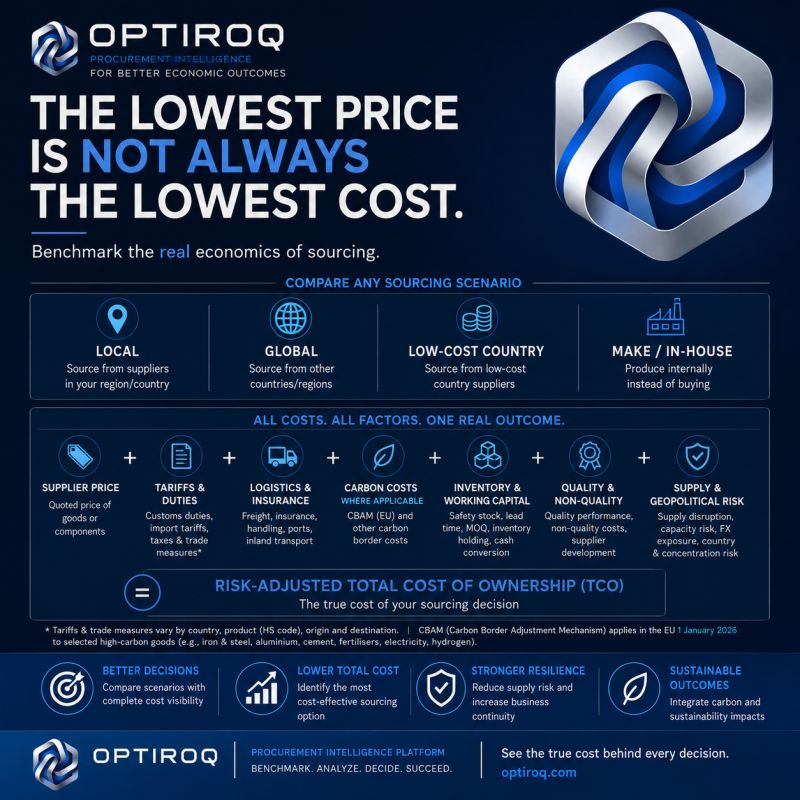
The cheapest supplier may no longer be the lowest-cost supplier.
What happens when your supplier quote is 3% cheaper…
…but your freight cost increases by 20%?
What happens when lead time doubles?
When you need additional safety stock?
When your insurance premium changes?
When an alternative source has to be qualified at short notice?
The current situation around the Strait of Hormuz is a powerful reminder.
Over the weekend, only 5 commodity vessels crossed Hormuz on Saturday — and none on Sunday, compared with more than 130 daily transits before the conflict.
For industrial procurement, this is not simply an energy-price problem.
It is a Total Cost of Ownership problem.
And even TCO is no longer enough.
We need to move from:
Purchase Price → Landed Cost → TCO → Risk-Adjusted TCO
Because the real question is no longer:
“Who gives me the lowest price?”
It is:
“Which sourcing option gives me the best economic outcome when cost, logistics, working capital, quality and supply risk are considered together?”
This is where Procurement Intelligence becomes critical.
At Optiroq, we believe RFQ analysis should not stop at comparing supplier quotations.
It should connect:
Supplier Price + Commodity Exposure + Logistics + Lead Time + Inventory + Quality + Supply Risk + Alternatives
to one decision:
What is the real cost of this sourcing decision?
The future of procurement is not about finding the cheapest supplier.
It is about understanding the true cost of the supply chain — before making the decision.